
Tandem solar cells face a sunlight reality check
GA, UNITED STATES, August 13, 2026 /EINPresswire.com/ -- Two-terminal (2T) perovskite/silicon tandem solar cells

Press Release Disclaimer: This is a press release distributed through the XPR Media network. It has not been independently verified by our newsroom.
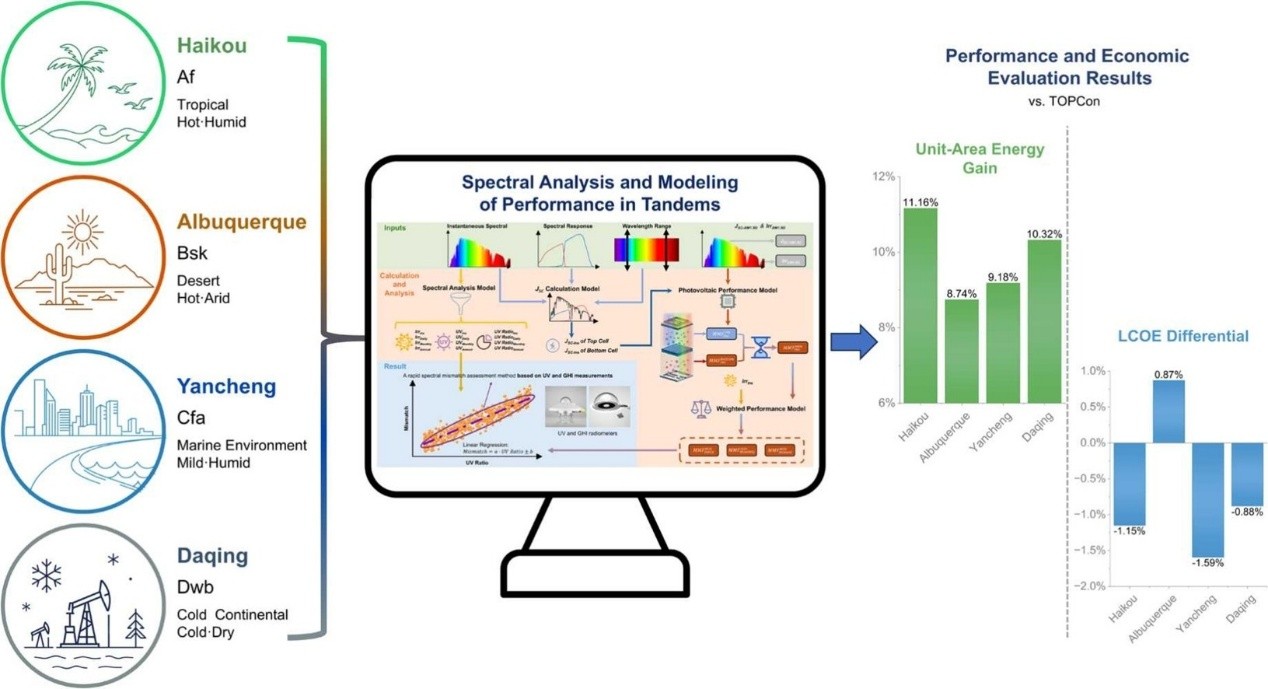

GA, UNITED STATES, August 13, 2026 /EINPresswire.com/ — Two-terminal (2T) perovskite/silicon tandem solar cells promise a major step beyond conventional silicon photovoltaics (PV), but their field performance depends on the color balance of sunlight as well as headline efficiency. A new study shows that shifting outdoor spectra can weaken current matching between the two sub-cells in 2T tandems, reducing energy output per watt under real skies. The researchers combined laboratory testing, year-round solar-spectrum datasets, software modeling, and economic simulation to measure this hidden loss across major PV climate zones. Even with spectral penalties, the devices produced more electricity per land area than single-junction silicon, pointing to practical routes for more efficient solar deployment in land-constrained, high-demand power markets and grid-scale planning.
Silicon modules still dominate the photovoltaics (PV) market, yet their power conversion efficiency (PCE) is approaching a practical limit. Tandem cells address this ceiling by stacking absorbers with different bandgaps so that each layer captures a different part of sunlight. In Two-terminal (2T) perovskite/silicon tandems, however, the sub-cells are connected in series, so the whole device is limited by the weaker current. Outdoor spectra shift with cloud cover, air mass (AM), atmospheric absorption, water vapor, season, and geography, making laboratory standard test conditions (STC) an incomplete guide for bankable energy forecasts. Based on these challenges, there is a need to conduct in-depth research into spectrum-driven performance losses in 2T tandem solar cells.
The study was conducted by researchers from Southwest Petroleum University, Tongwei Solar (Chengdu) Ltd., the Shanghai Institute of Microsystem and Information Technology, Chinese Academy of Sciences, and collaborating institutions in China. Published online on May 9, 2026, in eScience Energy, the research evaluated 2T perovskite/silicon tandem solar cells under globally varying spectral conditions and developed a practical framework to assess outdoor spectral mismatch, annual energy yield, and the levelized cost of electricity (LCOE) across representative PV deployment climates and operating environments worldwide.
The team fabricated 2T perovskite/silicon tandem cells and used a tunable light-emitting diode solar simulator to compare device behavior under standard, blue-rich, and red-rich spectra. The results confirmed the basic vulnerability of the 2T design: maximum output occurs only when the top perovskite sub-cell and the bottom silicon sub-cell are current matched. When the spectrum shifted, current mismatch reached 4.98% under blue-rich conditions and 4.32% under red-rich conditions, while corrected measurements showed that short-circuit current density (JSC) and efficiency followed the lower-current sub-cell. The researchers then built an outdoor spectral performance model using spectral response (SR) and the spectral mismatch factor (MMF). They analyzed long-term spectral data from Haikou, China; Albuquerque, United States; Yancheng, China; and Daqing, China, representing major Köppen–Geiger climate categories for PV deployment. Because full spectral measurements are often unavailable, they also proposed a faster method based on the ultraviolet (UV) ratio, calculated from UV irradiance and global horizontal irradiance (GHI). This simplified indicator showed a strong linear relationship with tandem current mismatch, offering a practical shortcut for site-specific assessment and future monitoring networks as projects move outdoors.
The authors said the work reframes tandem photovoltaics as a field-performance question, not only an efficiency race. They said 2T tandem cells are more sensitive to spectral variation than single-junction silicon because each sub-cell responds to a narrower wavelength range and the lower-current sub-cell controls the whole device. By connecting device physics, outdoor spectra, and cost analysis, the study gives manufacturers and project developers a clearer way to judge where tandems can deliver the greatest value. They said the model can also guide spectrum-aware device design for different climates and market conditions before large-scale commercial rollout.
The application value lies in translating laboratory promise into deployment strategy. Across four climates, tandem cells showed annual spectrum-related energy losses of 0.77% to 3.25% per watt compared with single-junction silicon. However, their higher module power enabled 8.74% to 11.16% more annual energy yield per unit area, a key metric for utility-scale projects where land and balance-of-system costs matter. System simulations further showed that improved land-use efficiency and direct-current (DC)-side balance-of-system (BOS) savings could reduce LCOE by up to 1.59% in favorable regions and support a tandem module price premium of up to 7%. The findings suggest that future tandem commercialization should pair high-efficiency cells with climate-specific spectral evaluation.
References
DOI
10.1016/j.esen.2026.100065
Original Source URL
https://doi.org/10.1016/j.esen.2026.100065
Funding information
Sichuan Science and Technology Program (2024ZDZX0030); Chengdu Science and Technology Program (2025-GH02–00012-HZ); National Natural Science Foundation of China (T2322028, 62474184); CAS Project for Young Scientists in Basic Research (YSBR-102); Talent Plan of Shanghai Branch, Chinese Academy of Sciences (CASSHBQNPD-202–001).
Lucy Wang
BioDesign Research
email us here
Legal Disclaimer:
EIN Presswire provides this news content “as is” without warranty of any kind. We do not accept any responsibility or liability
for the accuracy, content, images, videos, licenses, completeness, legality, or reliability of the information contained in this
article. If you have any complaints or copyright issues related to this article, kindly contact the author above.

Media gallery

