College Athlete NIL Rights: Eligibility Now an Economic Issue
K Altman Law discusses how college athlete eligibility decisions directly impact NIL income, roster spots, and economic rights in the wake of the LSU-SEC legal battle.

Press Release Disclaimer: This is a press release distributed through the XPR Media network. It has not been independently verified by our newsroom.
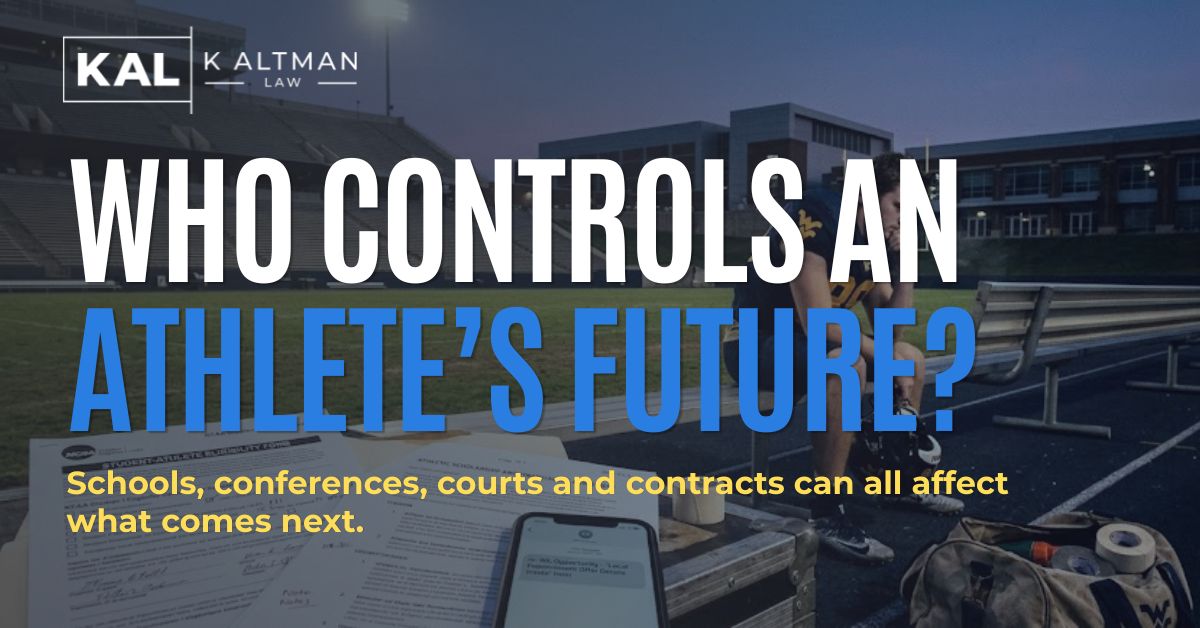

As schools, conferences, and courts clash over who may compete, eligibility decisions can also determine NIL income, roster access, scholarship value.
WASHINGTON, DC, UNITED STATES, September 8, 2026 /EINPresswire.com/ — Front Office Sports’ August 31 report, “No One Is Backing Down in LSU-SEC Legal Battle,” describes a fast-moving dispute over whether athletes who participated in NFL preseason activities may return to college competition and whether the Southeastern Conference may penalize member schools that roster them. LSU’s effort to add at least two affected players has placed individual eligibility claims at the center of a broader conflict among athletes, schools, conferences, and the NCAA.
The confrontation escalated Thursday when, as Front Office Sports subsequently reported, the SEC filed a federal lawsuit against LSU, university officials, and head coach Lane Kiffin seeking confirmation that the conference may enforce its rules. At the same time, a Louisiana court was considering whether to extend protections that had temporarily prevented the NCAA and SEC from blocking or penalizing the affected athletes and schools. The proceedings remain ongoing, and the merits have not been finally resolved.
K Altman Law says the conflict carries an important NIL lesson: eligibility and economic rights can no longer be treated as separate tracks. A decision about whether an athlete may compete can immediately affect roster access, scholarship value, NIL leverage and income, existing endorsement obligations, transfer options, and professional exposure.
“Eligibility is no longer only a playing-time question. It can determine whether an athlete keeps a roster opportunity, preserves scholarship value, earns NIL compensation, and maintains a path to a professional career. When rules change while an athlete is making irreversible choices, the athlete needs independent counsel whose only client is the athlete – not the school, conference, collective, or agent – to identify the controlling rule, the real deadline, the contract consequences, and the available remedies.”
– Candice Lapham, Senior Attorney, K Altman Law
The dispute also shows why athletes must identify who controls each decision. A court order directed at one organization may not resolve what a conference, school, collective, brand, or agent will do. Likewise, school support may advance an athlete’s roster interests without addressing the athlete’s individual contracts, repayment obligations, insurance, academic status, or long-term commercial rights.
What athletes and families should document immediately
– Eligibility record: Written eligibility decisions, governing rules, waiver requests, appeals, court orders, and a chronology of seasons and professional activity.
– Authority and deadlines: Who may decide – NCAA, conference, school, or court; which parties are bound; and all roster, portal, enrollment, hearing, and appeal deadlines.
– NIL and contract effects: NIL, endorsement, agent, or professional terms tied to participation, status, transfer, exclusivity, termination, repayment, or clawbacks.
– Economic and career impact: Scholarship and roster value, lost compensation, training access, insurance, draft exposure, and records needed to preserve claims and remedies.
These issues move quickly. Athletes should preserve every written decision, rule, contract, communication, payment record, and deadline. They should not assume a temporary order is final, that an institution’s lawyer represents them, or that eligibility clearance answers the separate question of what their NIL or professional agreements require.
K Altman Law advises student-athletes and families on eligibility and waiver disputes, school and conference actions, NIL contract review, payment and performance disputes, collective, brand, and agent conflicts, transfer and roster issues, misuse of identity or content, and related Title IX and civil-rights concerns. Early legal review is especially important when an injunction may expire, a roster deadline is approaching, a professional contract must be terminated or repaid, or a commercial agreement is tied to participation.
Candice K. Lapham
K Altman Law
+1 888-984-1341
kalonline@kaltmanlaw.com
Visit us on social media:
LinkedIn
Instagram
Facebook
YouTube
TikTok
X
Legal Disclaimer:
EIN Presswire provides this news content “as is” without warranty of any kind. We do not accept any responsibility or liability
for the accuracy, content, images, videos, licenses, completeness, legality, or reliability of the information contained in this
article. If you have any complaints or copyright issues related to this article, kindly contact the author above.

Media gallery