Dr. Juan Carlos Rey Explores Why Human Beings Have Always Believed in an Invisible World
Years of research led Rey through the history of ritual, mysticism, divination, consciousness, and humanity’s belief in

Press Release Disclaimer: This is a press release distributed through the XPR Media network. It has not been independently verified by our newsroom.
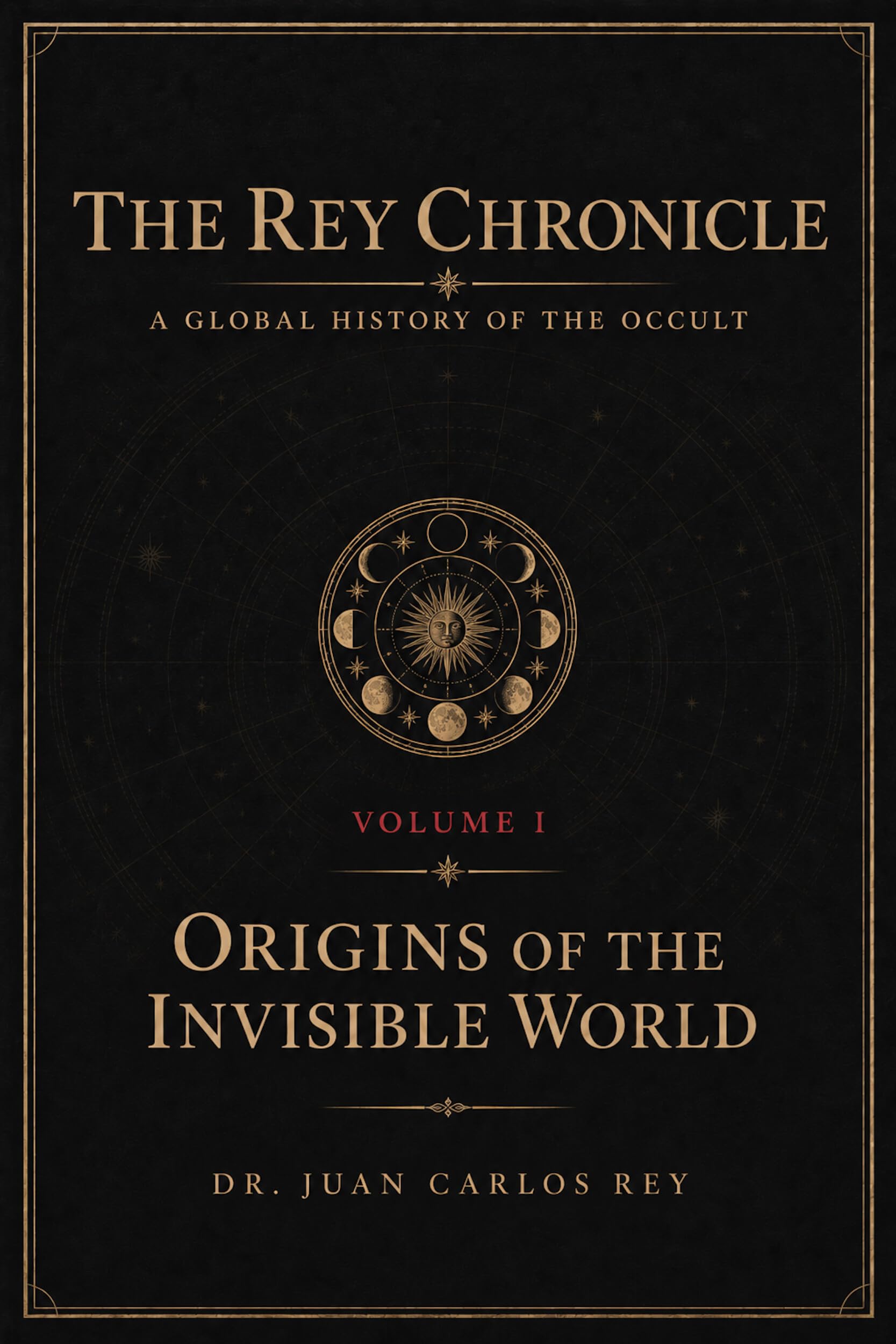

Years of research led Rey through the history of ritual, mysticism, divination, consciousness, and humanity’s belief in the unseen.
NEW YORK CITY, NY, UNITED STATES, September 18, 2026 /EINPresswire.com/ — Author, scholar, and host of The Observable Unknown begins an ambitious five-volume history of humanity’s encounters with magic, ritual, mysticism, divination, consciousness, and the unseen.
Long before people wrote histories, they buried their dead with objects, watched the sky for signs, cast lots, consulted dreams, marked sacred days, protected homes against unseen dangers, and asked questions that remain remarkably familiar:
What is happening to us?
What comes next?
What cannot be seen, but may still be acting upon our lives?
Why human beings have returned to those questions across cultures and across thousands of years became the historical problem Rey set out to understand.
Those questions sit at the heart of Rey’s newest and most ambitious work, The Rey Chronicle: A Global History of the Occult, Volume I: Origins of the Invisible World.
The book opens a five-volume historical project tracing humanity’s relationship with ritual, divination, magic, mystical experience, astrology, alchemy, spirit communication, sacred knowledge, and the many ways people have attempted to understand forces believed to exist beyond ordinary perception.
For Rey, the project is less about proving or disproving the supernatural than about taking human beings, and the questions they have asked for millennia, seriously. “People have always lived in worlds larger than what they could immediately see,” Rey says.
“Whether we are talking about an omen tablet in Mesopotamia, a funerary text in Egypt, a Chinese divination system, a medieval grimoire, or a family ritual practiced quietly for generations, these things tell us something about how human beings confronted uncertainty, death, power, fate, illness, hope, and the unknown.”
That human question gives The Rey Chronicle its unusual breadth. Volume I moves from prehistoric ritual and burial cultures through Mesopotamia, Egypt, Greece, Rome, the Near East, Africa, South Asia, East Asia, Southeast Asia, Jewish and Christian esoteric traditions, Islamicate occult sciences, Tantra, Daoist practice, astrology, alchemy, magical texts, and the intellectual currents that carried many of these traditions into the Renaissance.
Rather than forcing these cultures into a single universal history of “the occult,” Rey keeps their differences intact. A diviner in ancient China is not treated as though he were doing the same thing as a Renaissance magician. A mystical text is not automatically classified as a magical one. Religious practice, folk custom, philosophy, medicine, sacred kingship, divination, and ritual technologies are examined within their own historical settings.
For Rey, that distinction is nonnegotiable. Without it, global occult history collapses into a blur of false equivalences. “One of the problems with writing about occult history is that everything strange eventually gets thrown into the same box,” he says. “I wanted to resist that. Similarity is interesting, but difference is often where the history becomes most revealing.”
The Chronicle also separates historical evidence from inherited tradition. Its five-level evidence system allows readers to distinguish directly documented material from strong historical reconstruction, disputed interpretation, traditional attribution, and legendary or mythic chronology.
This makes the work accessible to two kinds of readers at once: the person who wants to read a sweeping history from beginning to end, and the student, scholar, or curious reader who wants to return to particular traditions, cultures, practices, periods, or source families as reference material.
The Rey Chronicle is also part of a much larger body of work. Across his books, lectures, research, and more than 170 episodes of The Observable Unknown, Rey has repeatedly returned to a difficult cluster of human questions: how consciousness interprets experience, how intuition becomes language, how ritual shapes attention, how people make decisions under uncertainty, how authority is constructed, and how human beings distinguish meaning from noise.
His wider oeuvre moves across neuroscience, consciousness studies, ritual, divination, behavioral timing, human judgment, magic, communication, and cultural history. Works including A Simplified Neuroscience of Intuition and The Architecture of Command approach these questions from very different directions.
His work in Temporal Architecture examines human judgment, timing, pressure, interpretation, and adaptive behavior. Other books explore chance, ritual calendars, decision-making, consciousness, symbolic systems, and the structures through which human beings organize experience.
What connects them is not a single subject. It is a question. How does a human being encounter an uncertain world, decide what something means, and choose what to do next?
The Rey Chronicle takes that question backward through history. Instead of asking only how modern people interpret uncertainty, Rey asks how human beings have been doing it for thousands of years.
Seen from that perspective, the history of the occult becomes something larger than a history of supernatural claims, secret teachings, or mysterious practices. It becomes a history of human beings attempting to live intelligently inside uncertainty.
Fate, death, illness, dreams, altered states, sacred authority, prophecy, memory, coincidence, revelation, protection, ancestors, spirits, stars, numbers, and invisible causes appear again and again across civilizations, even when the explanations surrounding them differ radically.
Some traditions disappeared. Some survived quietly. Some were condemned, absorbed, rewritten, renamed, rediscovered, or carried across borders into cultures that understood them differently. Others became so deeply woven into ordinary life that their origins are now almost invisible.
Rey sees those recurring questions as part of the human inheritance. “We inherit answers from the past,” he says. “But we also inherit questions. Some of the questions are extraordinarily old.”
The Rey Chronicle asks readers to look again at one of the oldest of them: Why have human beings, across so much of history, believed that the visible world was only part of the story?
The Rey Chronicle: A Global History of the Occult, Volume I: Origins of the Invisible World is available now.
For more information about the book and its author, please visit: https://www.drjuancarlosrey.com
The book is available at: https://a.co/d/0bVKN67u
For review copies, interview requests, or additional information, please contact:
Dr. Juan Carlos Rey
BrightKey PR
juancarlosreyphd@gmail.com
Legal Disclaimer:
EIN Presswire provides this news content “as is” without warranty of any kind. We do not accept any responsibility or liability
for the accuracy, content, images, videos, licenses, completeness, legality, or reliability of the information contained in this
article. If you have any complaints or copyright issues related to this article, kindly contact the author above.

Media gallery