Survey: Many Americans pulled away from religion, then declined to pay for its replacement
Practical Enlightenment reports that a recent survey found 57% of Americans have pulled away from organized religion,

Press Release Disclaimer: This is a press release distributed through the XPR Media network. It has not been independently verified by our newsroom.


Shevchuk__Bohdan // Shutterstock
For a decade, the story has written itself. Americans walked away from organized religion, with 2025 reporting as the lowest faith levels recorded, and a booming spiritual wellness economy of astrology apps, tarot readers, crystal sellers and retreat hosts stepped in to catch them. For years, coverage of the wellness boom and its creator economy has treated the trade as settled fact.
A new national survey of 1,000 U.S. adults commissioned by Practical Enlightenment tells a different story. The exodus is real: 57% of respondents reported leaving or significantly pulling back from a religion they were raised in or previously practiced.
The replacement purchase never happened. Six in ten respondents (63%) reported spending nothing at all in the past 12 months on spiritual or wellness practices outside organized religion, a category that includes astrology apps, tarot readings, crystals, sound baths and retreats.
The gap runs deeper than spending. Asked where they actually turn for meaning and grounding, respondents ranked astrology, tarot and crystals dead last of nine options. Asked which sources they trust for spiritual or moral guidance, they ranked spiritual teachers and online creators below every other option tested, including the organized religion those creators are supposed to be replacing.
Key findings
- 63% of respondents reported spending $0 in the past 12 months on spiritual or wellness practices outside organized religion, including astrology apps, tarot readings, crystals, sound baths and retreats
- Only 3% reported spending $500 or more, and just 1% spent $1,000 or more
- Astrology, tarot and crystals finished last of nine sources of grounding at 5%, behind nature (42%), trusted friends and family (33%) and physical movement (26%)
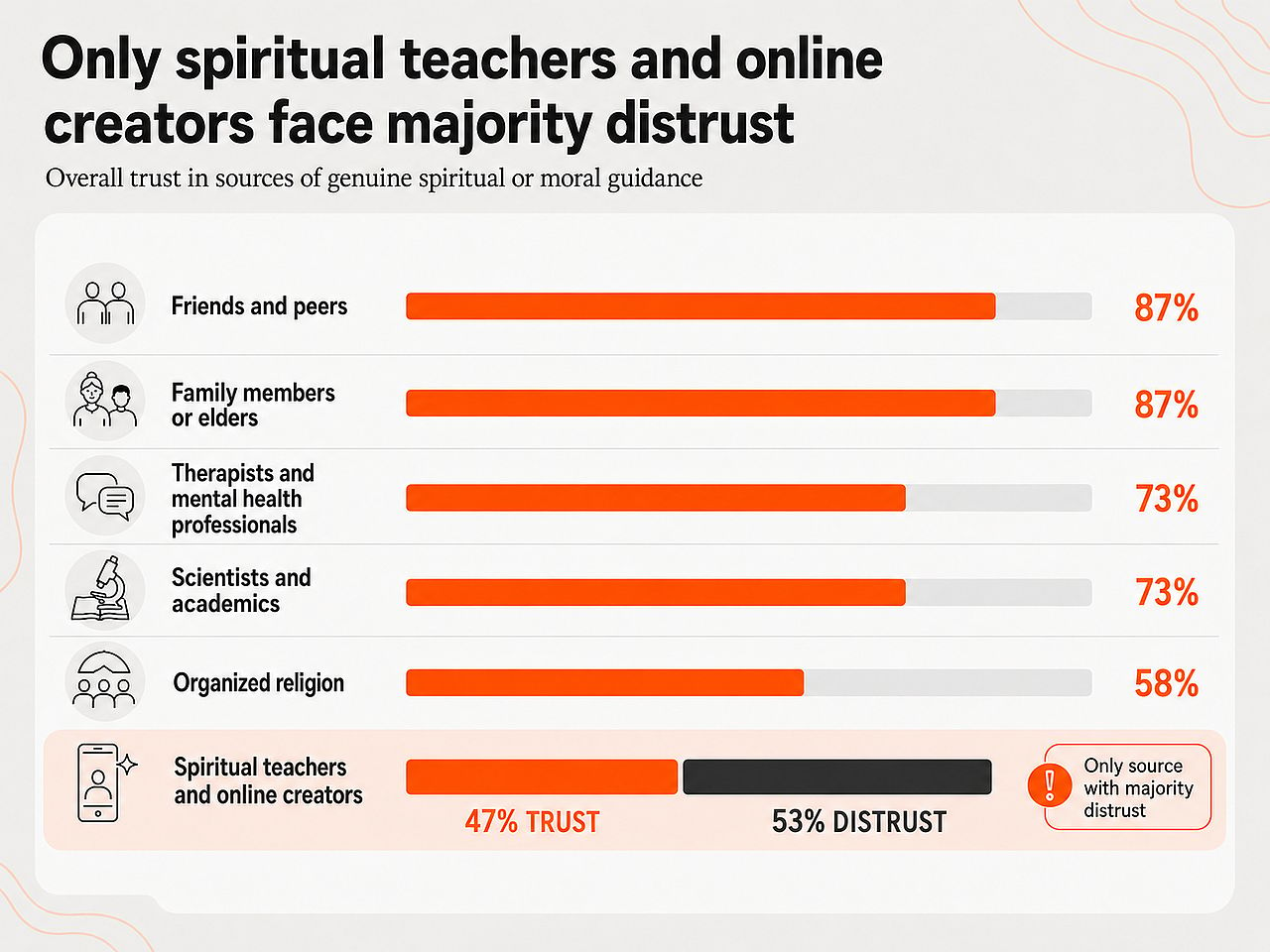
- Spiritual teachers and online creators are the only guidance source of six tested that more respondents distrust (53%) than trust (47%)
- 51% of respondents take a critical view of the wellness industry; only 20% say it provides genuine spiritual value
- 57% of respondents reported leaving or significantly pulling back from a religion they were raised in
- 18% name their single biggest obstacle as knowing what they believe but having no structure or accountability to live by it
The exodus is real, and it reshaped who Americans are
Practical Enlightenment
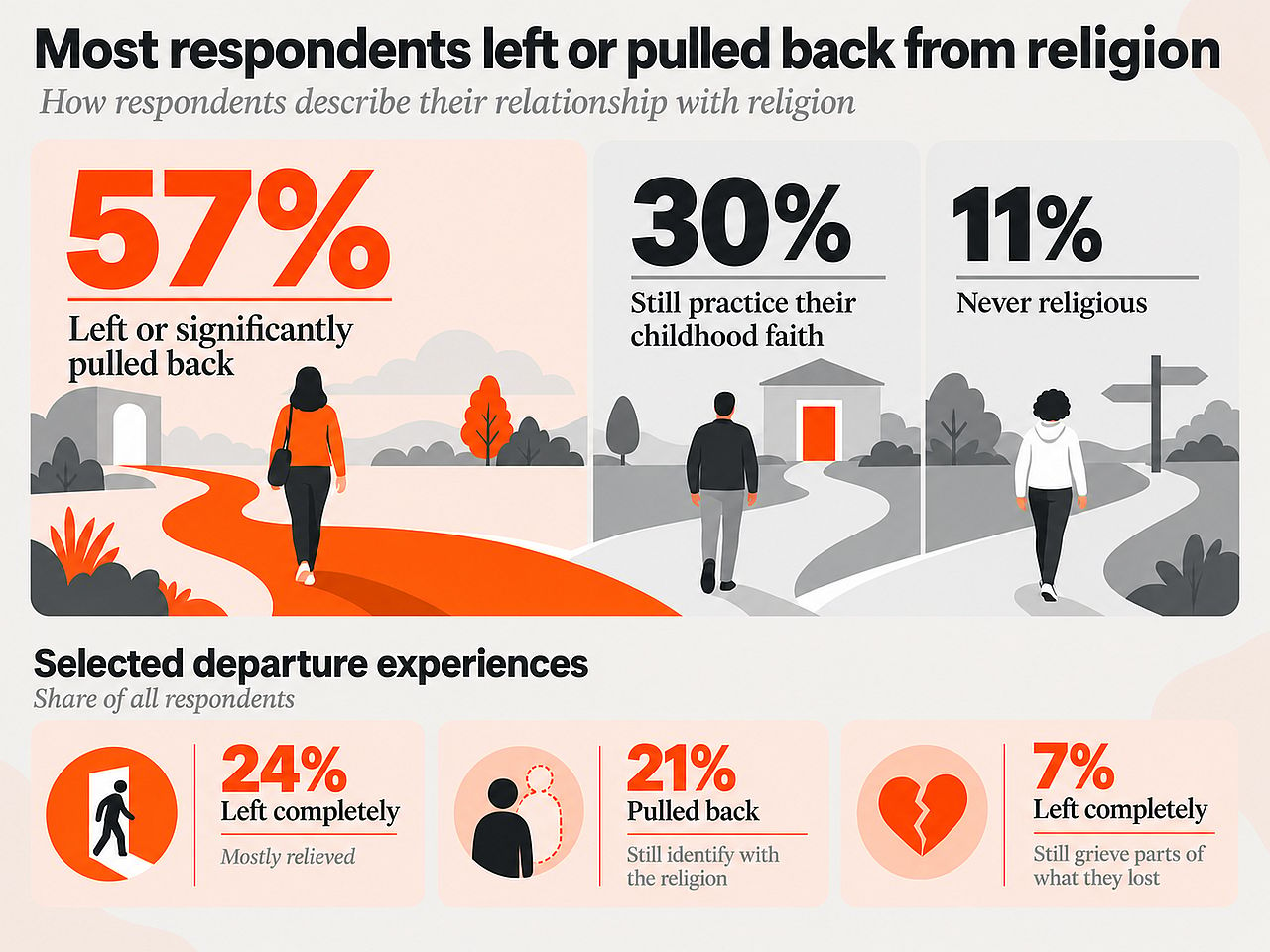
Departure, not lifelong secularism, is what changed American belief. Just 11% of respondents said they were never religious in the first place. A much larger 57% reported leaving or significantly pulling back from a religion they were raised in or previously practiced, and only 30% still practice the faith of their childhood.
The largest single group of leavers, 24% of respondents, left completely and say they mostly feel relieved. Another 21% pulled back but currently still identify with the religion, and 7% left completely but still grieve parts of what they lost.
That is the population the wellness economy has spent a decade courting: well over a hundred million adults who loosened or cut ties with the institutions that once structured their spiritual lives. On paper, it’s a perfect customer base. The survey suggests the industry never closed the sale.
Most Americans spent nothing on the replacement
Practical Enlightenment
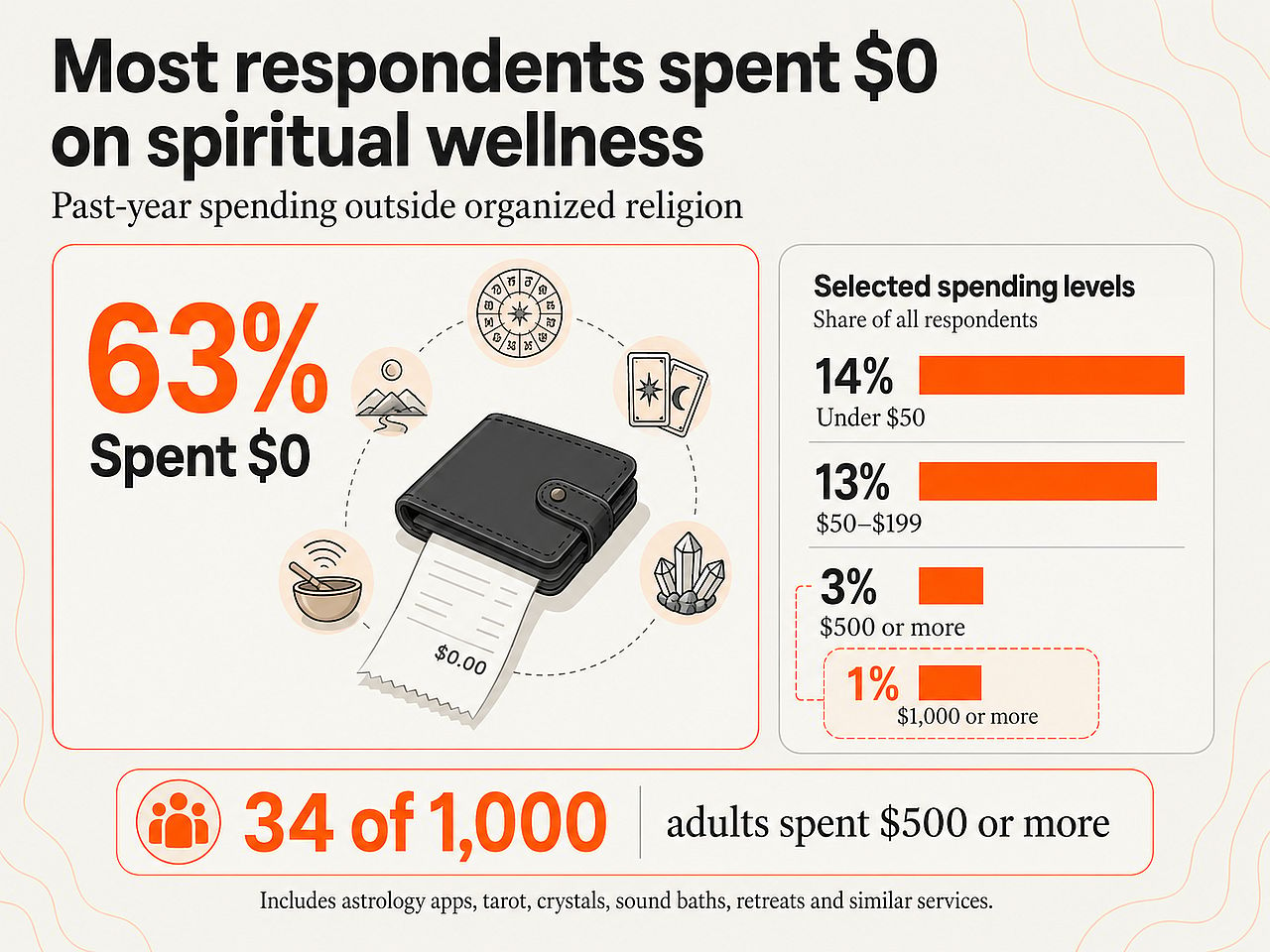
Fully 63% of respondents reported spending $0 in the past 12 months on spiritual or wellness practices outside organized religion, a category defined in the survey to include astrology apps, tarot readings, crystals, sound baths, retreats and similar services.
Among the group who spent anything, most spent little: 14% of respondents spent under $50 and 13% spent between $50 and $199. Only 3% of respondents reported spending $500 or more, and just 1% cleared $1,000. In a sample of 1,000 adults, the entire $500-and-up tier amounts to 34 people.
The spiritual wellness industry has been covered for years as a fast-growing commercial category, with astrology apps and creator-led content among its most-hyped corners. The survey cannot measure revenue. What it can measure is the American customer base, and it finds a growth story resting on a small and heavily concentrated minority of buyers rather than a mass migration of religious leavers.
When Americans need grounding, they go outside
Practical Enlightenment
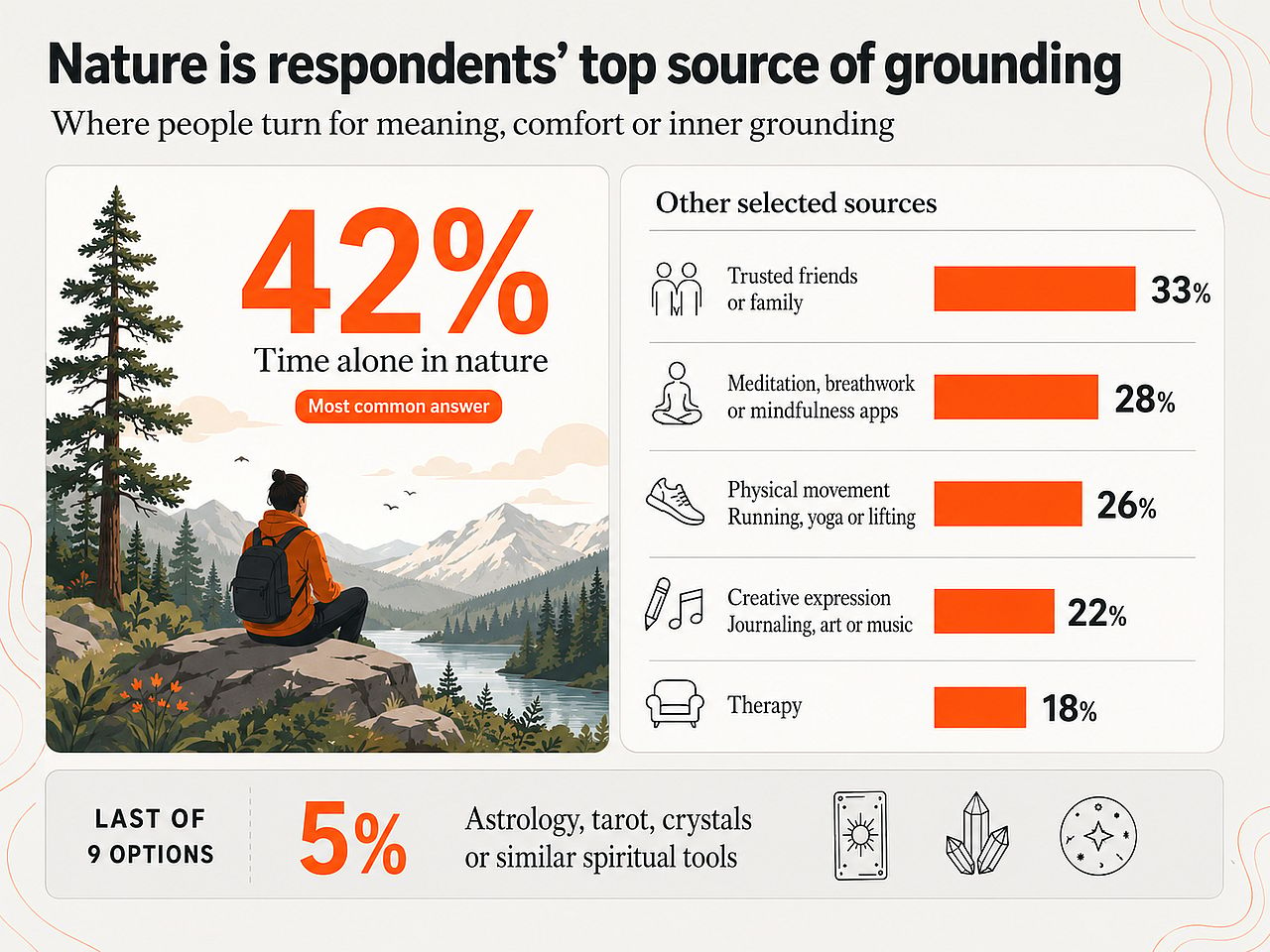
Asked where they actually turn when they need meaning, comfort or inner grounding, respondents put the wellness industry’s flagship products at the bottom of the list. Astrology, tarot, crystals and similar spiritual tools finished last of nine options at 5%.
The top of the list costs nothing: 42% turn to time alone in nature, which respondents rated the closest thing they have to a sacred practice, making it the single most common answer. A tight circle of trusted friends or family came second at 33%. Physical movement such as running, yoga or lifting drew 26%, creative expression like journaling, art or music drew 22% and therapy drew 18%. Meditation, breathwork and mindfulness apps, the most commercially successful corner of the category, reached 28%.
The pattern is consistent: The sources respondents rely on most are largely free. Nature, friends and movement top the list, and the retail end of the category, astrology, tarot and crystals, barely registers at 5%. The one commercial product with real traction, meditation apps at 28%, is the one that sells a daily practice rather than an object.
Spiritual influencers are the least trusted guides in America
Practical Enlightenment
Respondents rated six sources of genuine spiritual or moral guidance on a four-point trust scale, and one source stood alone. Spiritual teachers and online creators were the only option that more respondents distrust (53%) than trust at any level (47%).
Every other source netted positive. Friends and peers and family members or elders effectively tied at the top, each at 87% trust. Therapists and mental health professionals reached 73% and scientists and academics 73%. Organized religion, for all its reputational damage, still drew 58% trust, nearly 11 points above the creators positioned as its successors.
Coverage of the spiritual wellness boom has centered on the rise of creator-led spiritual content. The survey suggests the public sees those creators differently than the growth numbers imply. The trust that left the pulpit shows no sign of arriving at the feed.
Americans judge the industry more harshly than the religion it replaced
Practical Enlightenment
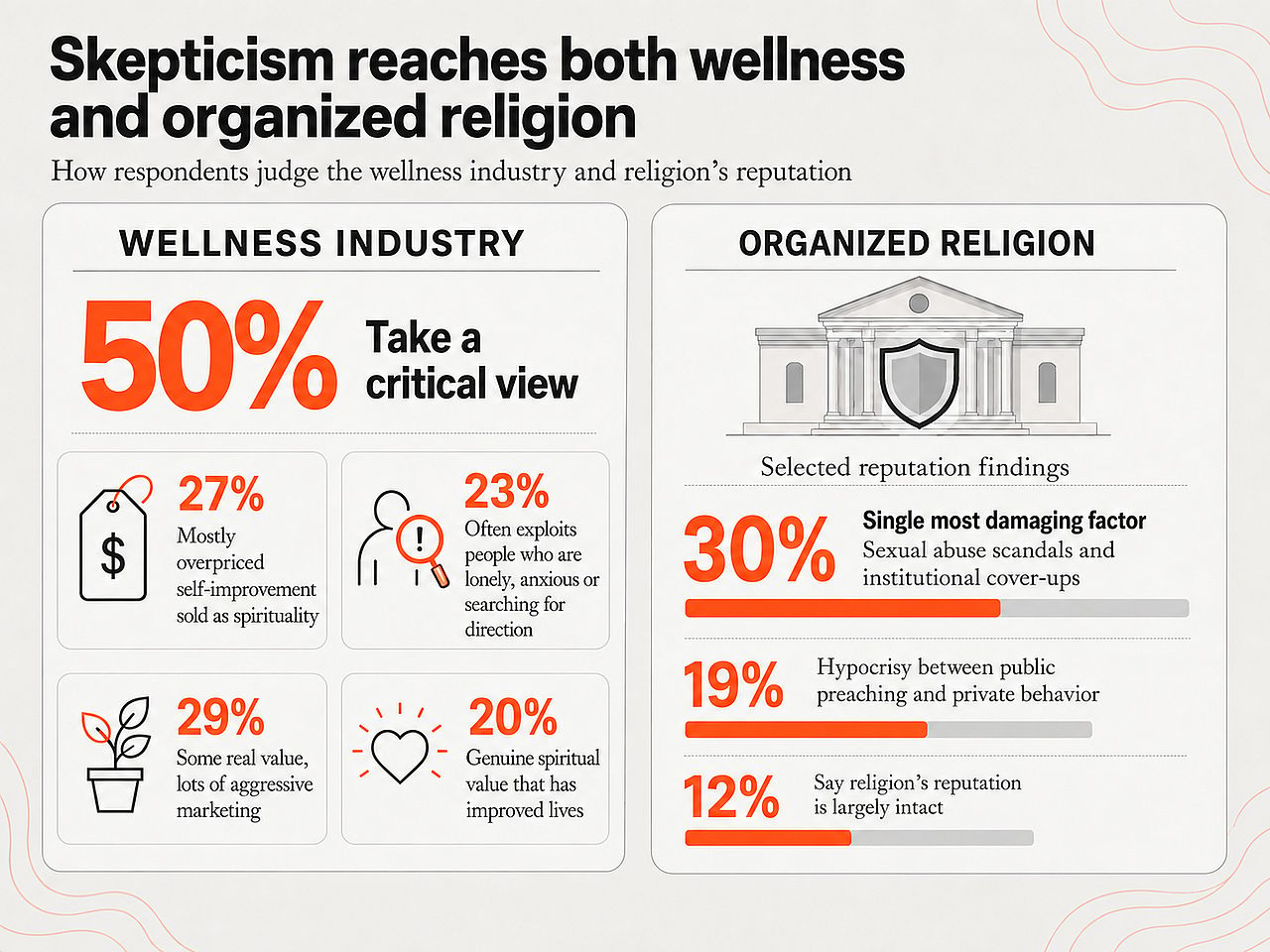
The distrust extends past the personalities to the business model. Half of respondents (50%) take a critical view of the wellness industry: 27% call it mostly overpriced self-improvement presented as spirituality, and another 23% say it often exploits people who are lonely, anxious or searching for direction. Only 20% say it provides genuine spiritual value and has improved lives, while 29% land in the middle, seeing some real value alongside a lot of aggressive marketing.
Organized religion takes its own beating in the data. Nearly a third of respondents (30%) name sexual abuse scandals and institutional cover-ups as the single most damaging factor to religion’s reputation, and 19% point to hypocrisy between what leaders preach and how they privately behave. Just 12% think religion’s reputation is largely intact.
The two findings together sketch an unusual consumer: someone who walked away from one institution over trust and looked at its commercial replacement with the same skepticism, sharpened.
What people say they want was never for sale
Practical Enlightenment
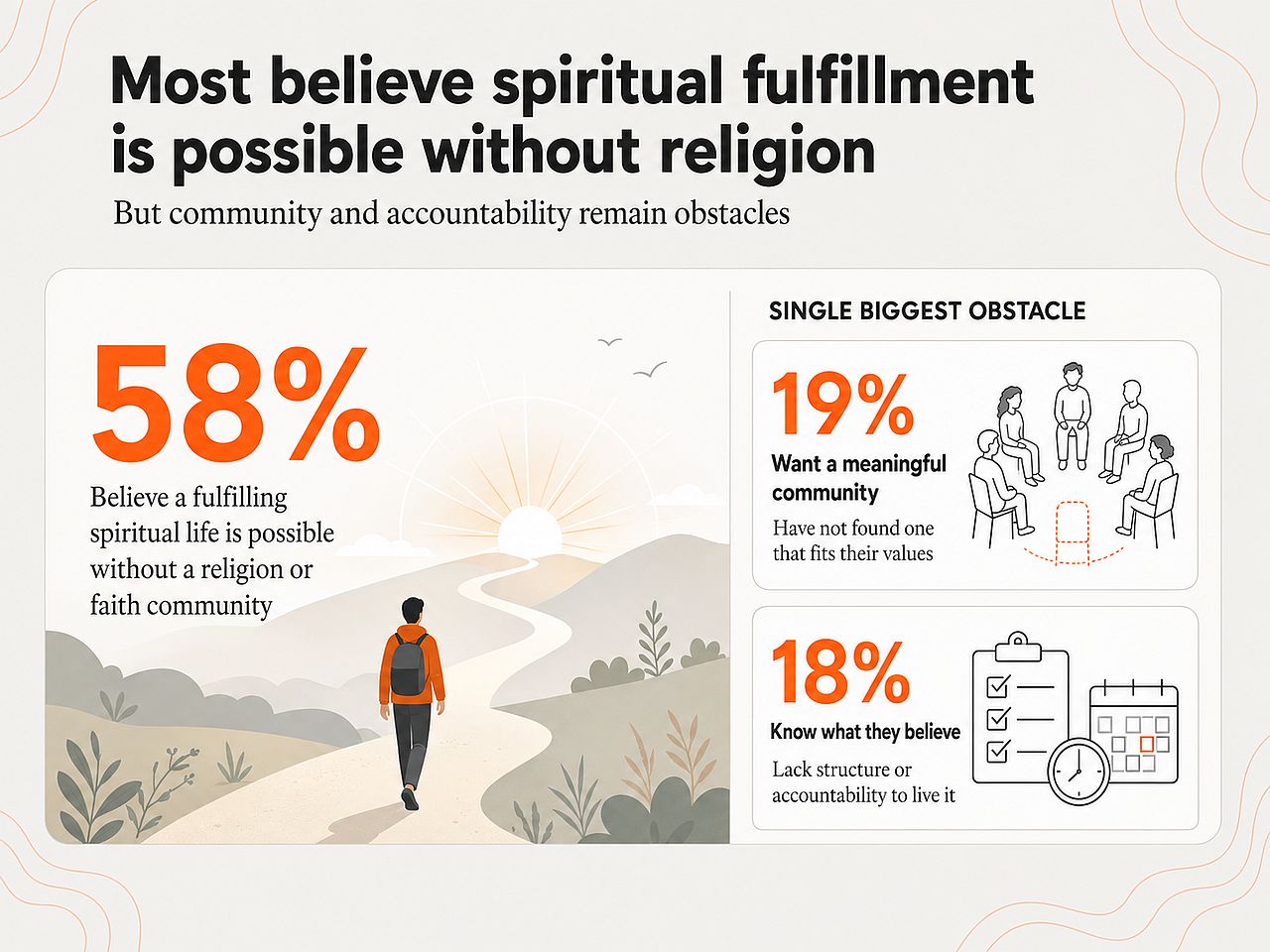
The survey finds real demand, just not for the products on offer: 58% of respondents believe a genuinely fulfilling spiritual life is possible without belonging to a religion or faith community. Far fewer have built one: 18% name their single biggest obstacle as knowing what they believe but having no structure or accountability to actually live by it, and another 19% say they want a meaningful community but have not found one that fits their values.
Asked what they would include if designing a spiritual practice from scratch, the top answers were regular time in nature (28%), a real-world community of people who share their values (27%) and honest conversations about death and meaning (24%).
The appetite for structure is measurable: 44% of all respondents said they would be at least somewhat likely to use a structured, rational, nonreligious platform for building an inner life. Among Gen Z the figure rises to 59%, and among parents of children under 18 it reaches 52%. The people furthest from the pews are the ones most openly asking for a framework, and the survey suggests the current market has been selling them merchandise instead.
Summary
The last decade produced two competing stories about American belief. In one, religion collapsed and left a vacuum. In the other, a booming wellness industry filled it. This survey suggests the second story confused revenue growth with cultural change. Most Americans who left religion took their meaning-seeking somewhere no company can invoice: a trail, a kitchen table, a long run, a hard conversation with someone they trust.
What they have not found is structure. Nearly one in five respondents can articulate what they believe and cannot find a way to live by it, and slightly more are still looking for a community that fits. The unmet demand in American spiritual life turns out not to be for products at all. It is for the two things religion actually provided, accountability and belonging, offered without the parts people left over. That audience, for all the industry’s growth, is still waiting.
Methodology
To understand how Americans approach spirituality and meaning outside organized religion, Practical Enlightenment surveyed 1,000 U.S. adults across the country via Pollfish in July 2026. Participants answered questions about their religious history, spiritual practices, spending on spiritual and wellness services, trust in sources of guidance and interest in nonreligious structure. Responses were analyzed by demographic groups to identify trends and disparities. Multi-select questions allowed more than one answer, so those percentages sum above 100. Survey percentages are rounded to whole numbers in this article; the underlying data is reported to one decimal place. Pollfish samples are non-probability panels; figures describe survey respondents and may not precisely mirror the U.S. adult population.
This story was produced by Practical Enlightenment and reviewed and distributed by Stacker.