The AI Money Revolution Maps the Financial Infrastructure Autonomous AI Agents May Need
Jason Ansell’s new book examines how autonomous AI agents could earn, spend, settle payments, and participate in

Press Release Disclaimer: This is a press release distributed through the XPR Media network. It has not been independently verified by our newsroom.
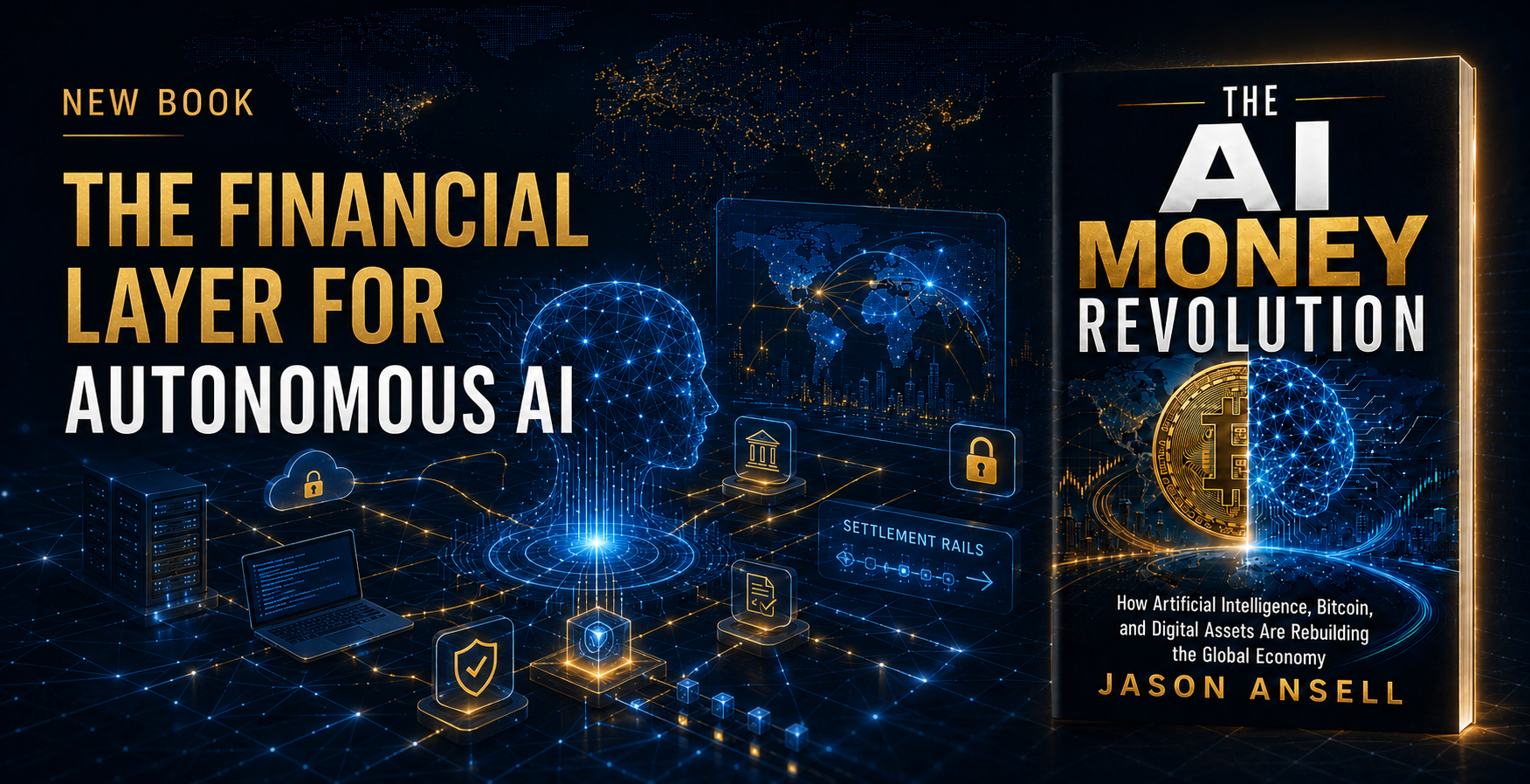

Jason Ansell’s new book examines how autonomous AI agents could earn, spend, settle payments, and participate in continuously operating markets.
TORONTO, ON, CANADA, August 3, 2026 /EINPresswire.com/ — Artificial intelligence is rapidly becoming capable of performing work, analyzing information, creating products, using software tools, and coordinating complex activities. Yet most financial infrastructure remains designed for people, businesses, banks, and governments—not autonomous software.
Canadian technology entrepreneur and author Jason Ansell examines this emerging gap in The AI Money Revolution: How Artificial Intelligence, Bitcoin, and Digital Assets Are Rebuilding the Global Economy.
The book asks a practical question: If an AI agent can perform economically valuable work, what infrastructure would allow it to receive compensation, purchase resources, settle obligations, and participate safely in global markets?
“Artificial intelligence can already create and coordinate increasingly sophisticated work, but economic participation requires more than intelligence,” said Ansell. “It requires access to value, payments, identity, markets, and accountable permissions. The book examines the infrastructure that may allow those elements to work together.”
Across 33 chapters organized into eight parts, The AI Money Revolution explores how autonomous systems could generate income through research, software development, content production, commerce, data analysis, and digital services. It also considers how agents might purchase computing power, access data, pay for software, acquire supplies, and compensate other agents.
Bitcoin, stablecoins, and programmable payments are examined as distinct components of this emerging economic layer.
The book considers Bitcoin’s potential role as scarce, neutral, digitally native money and a settlement network for an economy increasingly operated by software. Stablecoins are explored as continuously available payment rails, while programmable payments could allow value to move when work is completed, information is verified, contractual conditions are satisfied, or resources are consumed.
Tokenization is another central theme. Stocks, bonds, commodities, property, and intellectual property can increasingly be represented through software-accessible systems. As these markets evolve, AI agents may be able to analyze, exchange, rebalance, and manage digital assets across continuously operating networks.
The book also addresses the risks of allowing autonomous systems to control financial decisions. These include unauthorized transactions, AI-powered fraud, deepfake impersonation, market manipulation, privacy loss, identity disputes, and uncertainty over who is responsible when an agent causes financial harm.
“The economy becoming more intelligent does not automatically mean it becomes more open, fair, or secure,” Ansell added. “Decisions involving identity, access, privacy, governance, and responsibility will determine who benefits from these systems.”
Rather than presenting speculative price predictions, the book focuses on infrastructure, business models, institutional responses, and practical preparation. Its concluding chapters outline steps individuals, businesses, educators, and policymakers can take to improve AI and financial literacy, protect identity and credentials, maintain human oversight, and establish accountability for autonomous financial actions.
The AI Money Revolution is available in Kindle, audiobook, paperback, and hardcover formats. Its electronic edition is also being introduced across additional international retail and library networks.
Readers can find current editions and retailer options at:
https://theaimoneyrevolution.ca
Readers can explore the book’s details through Google Books:
https://books.google.com/books/about?id=7En7EQAAQBAJ
About Jason Ansell
Jason Ansell is a Canadian technology entrepreneur, author, publisher, and full-stack developer with more than 25 years of experience building digital platforms and online businesses. He is the co-founder of Vector Smart Chain and founder of Ansell Publishing. His work explores artificial intelligence, blockchain infrastructure, cryptocurrency, Web3, programmable finance, and the evolution of the digital economy.
About Ansell Publishing
Ansell Publishing is an independent Canadian publisher focused on artificial intelligence, blockchain, digital finance, emerging technology, and practical education. Its publications are designed to make complex technologies understandable while examining their economic and social implications.
Jason Ansell
Ansell Publishing
+1 888-271-7126
email us here
Legal Disclaimer:
EIN Presswire provides this news content “as is” without warranty of any kind. We do not accept any responsibility or liability
for the accuracy, content, images, videos, licenses, completeness, legality, or reliability of the information contained in this
article. If you have any complaints or copyright issues related to this article, kindly contact the author above.

Media gallery