
Revenue, Not Cost, Now Decides Solar’s Next Winners
Across ten eFinancialModels Solar Energy Market Studies, capture rate and storage now decide a solar model's returns.

Press Release Disclaimer: This is a press release distributed through the XPR Media network. It has not been independently verified by our newsroom.

Across ten eFinancialModels Solar Energy Market Studies, capture rate and storage now decide a solar model’s returns.
ZURICH, SWITZERLAND, August 4, 2026 /EINPresswire.com/ — Building a solar plant has never been cheaper, yet the revenue each panel earns is shrinking. That is the pattern running through eFinancialModels‘ Solar Energy Market Studies, a series of ten country studies covering 2026 to 2031. For a founder building an investor-ready model, the old shortcut of opening with a low build cost no longer predicts returns. The variable that now decides them is the price each megawatt-hour actually captures once it reaches a crowded grid.
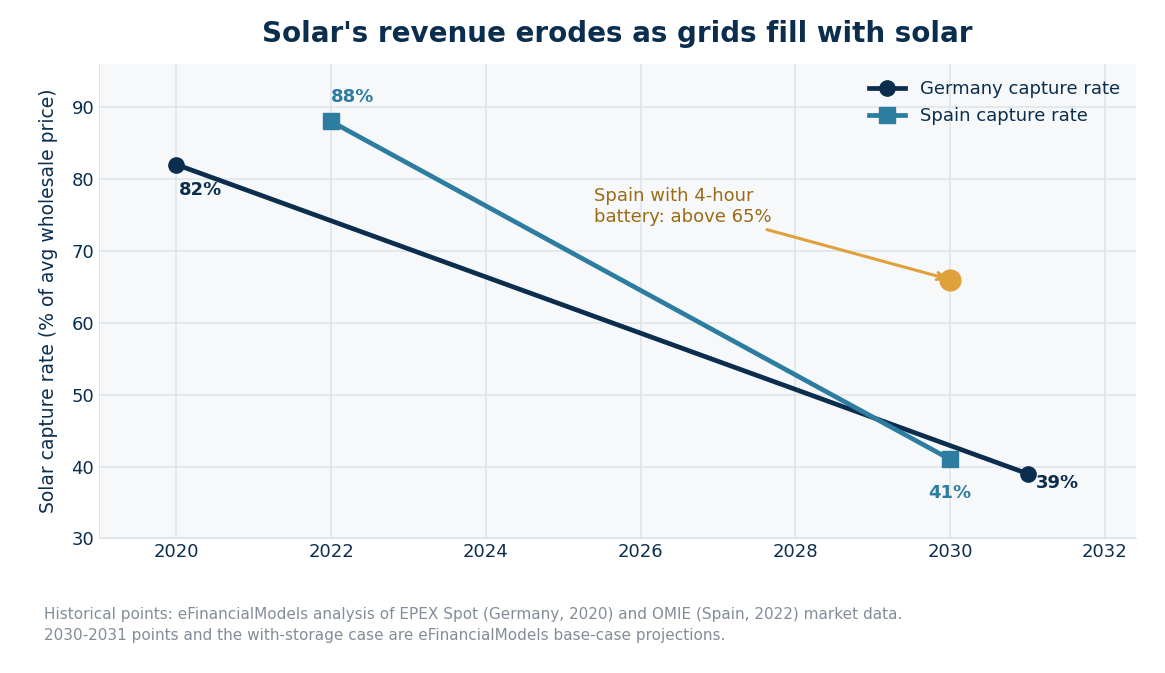
That price is falling fastest in Europe’s most saturated markets. Germany ran almost 575 hours of negative day-ahead power prices in 2025, a record, up from 459 in 2024, on research institute FfE’s analysis of EPEX Spot data. Those are hours when panels earn nothing. Against that, the eFinancialModels Germany study projects the solar capture rate falling from 82 percent in 2020 to 39 percent by 2031 in its base case, and its Spain study from about 88 percent in 2022 to 41 percent by 2030 without storage. Italy and Australia show the same erosion. In India and China the value leaks out as curtailment instead, when a full grid forces plants to switch off. China’s national solar curtailment hit 6.6 percent in the first half of 2025 against 3.9 percent a year earlier, easing to about 5 percent across the full year (National Energy Administration), and Ember reports India lost 2.3 TWh to grid constraints from May to December 2025.
The build side runs the other way. Solar keeps getting cheaper in every major market the studies cover except the United States, where tariffs and tighter federal financing rules pushed costs up instead: SEIA and Wood Mackenzie put US utility-scale system costs 11 to 14 percent higher year on year in the fourth quarter of 2025. Cheaper hardware no longer explains which projects earn the most.
“Cheaper hardware is real, but it is not the story anymore,” said a spokesperson for eFinancialModels. “Across these markets the decisive question has shifted from what solar costs to build to what each panel keeps once the grid is full of it, and the studies show storage is what defends that revenue.”
The Spain study makes the point concretely: in its base case, adding a four-hour battery keeps the capture rate above 65 percent rather than 41 percent. For a project model, that turns the battery from an optional extra into a core revenue line.
Governments are underwriting the same shift. Italy’s grid operator Terna cleared its first MACSE storage auction in October 2025, contracting 10 GWh for delivery in 2028, and the Australian government’s Capacity Investment Scheme is tendering a further 16 GWh under long-term revenue underwriting. Where market revenue thins, contracted revenue is replacing it.
For founders building a solar model, four assumptions now matter most. Model the capture rate, not just the levelized cost, using a declining capture-rate path rather than a flat wholesale price. Put storage in the base case, because in Spain a four-hour battery lifts capture from 41 to above 65 percent. Stress-test zero-revenue hours, because Germany’s negative-price hours reached almost 575 in 2025, a record. And localize the cost curve, because costs are falling in most markets but rose 11 to 14 percent in the United States in late 2025.
The Solar Energy Market Studies are available as a free download, alongside eFinancialModels’ renewable energy financial model templates.
This release is provided for informational purposes only and does not constitute financial, investment or professional advice. Projections are eFinancialModels base-case estimates and are not forecasts of actual results.
Communications Team eFinancialModels
eFinancialModels
info@efinancialmodels.com
Visit us on social media:
LinkedIn
Bluesky
Instagram
Facebook
YouTube
TikTok
X
Legal Disclaimer:
EIN Presswire provides this news content “as is” without warranty of any kind. We do not accept any responsibility or liability
for the accuracy, content, images, videos, licenses, completeness, legality, or reliability of the information contained in this
article. If you have any complaints or copyright issues related to this article, kindly contact the author above.

Media gallery

