States where home insurance got cheaper, and what they’re doing right
Insurance.com reports that despite rising national homeowners insurance rates, 16 states saw average annual premiums

Press Release Disclaimer: This is a press release distributed through the XPR Media network. It has not been independently verified by our newsroom.



Sean Pavone // Shutterstock
States where home insurance got cheaper, and what they’re doing right
Although homeowners insurance rates have been rising significantly across the nation, new Insurance.com data shows that 16 states saw average annual premiums fall from 2025 to 2026.
There’s no single reason for these decreases. In some states, targeted resilience grants, insurance discounts, and a slower-than-normal storm season in 2025 may have helped, while others may be benefiting from increased competition or changes in insurers’ pricing.
As many states continue to face rate increases, are there lessons to be learned from those where homeowners are seeing some rate relief?
Key takeaways:
- Arkansas (-$538), North Carolina (-$256), and Missouri (-$196) saw the largest decreases in home insurance rates.
- Many states offer grants for homeowners to strengthen their homes against wind and severe weather damage.
- North Carolina approved two 7.5% base-rate increases from 2025 to 2026, but actual home insurance rates went down.
Which states saw home insurance rates go down in 2026?
States with the largest decreases in annual home insurance premiums are Arkansas (-$538), North Carolina (-$256), Missouri (-$196), North Dakota (-$136), and Mississippi (-$131). D.C. (-$98), Rhode Island (-$98), Pennsylvania (-$74), South Carolina (-$64), and Vermont (-$46) have shown more moderate decreases.
However, not all states are seeing relief from high home insurance rates. Some states have seen significant rate increases, including Nebraska (+$960), New Mexico (+$628), Colorado (+$548), and Florida (+$543).
These are the top 10 states for homeowners insurance increases and decreases from 2025 to 2026.
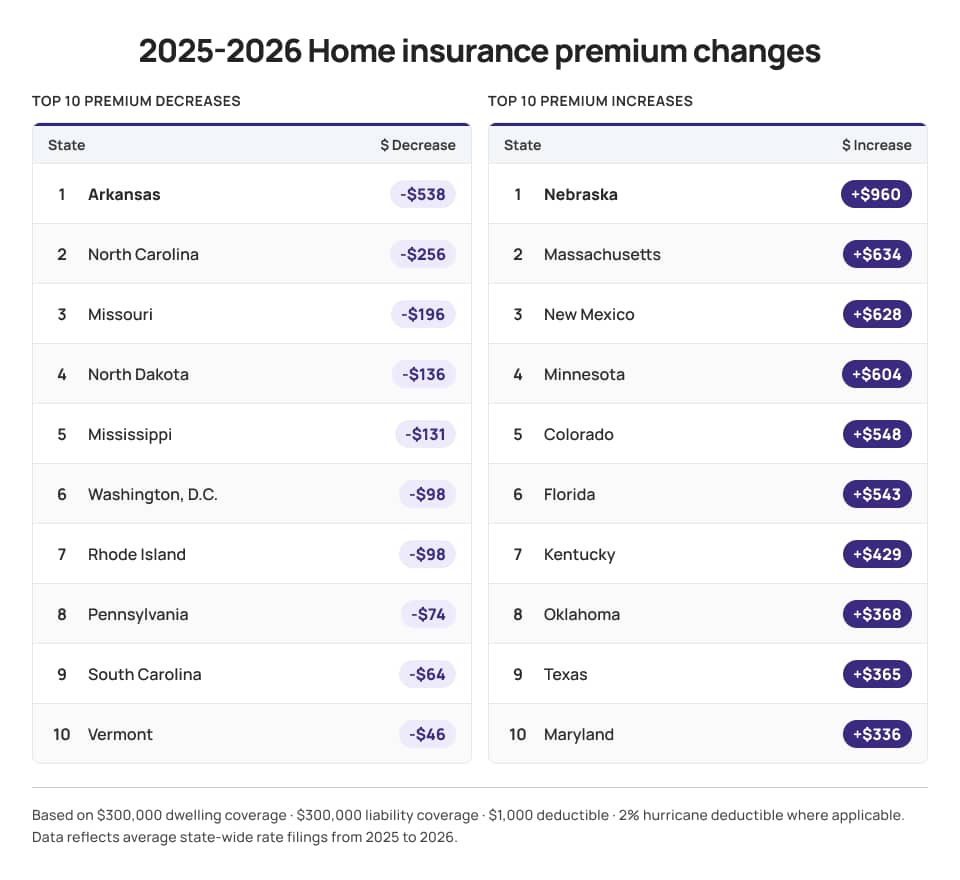
Insurance.com
The map below shows the percentage change in home insurance rates in every state and D.C. from 2025 to 2026. Rates are based on coverage of $300,000 dwelling, $300,000 liability, a $1,000 deductible, and a 2% hurricane deductible, where applicable.
 Heatmap 2025-2026.png)
Insurance.com
Arkansas case study: Where rates fell $538
Arkansas had the largest annual home insurance premium reduction, at $538. Although Arkansas has historically had high home insurance rates due to severe weather risks, such as tornadoes and hail, it saw the steepest decline in premiums from 2025 to 2026.
The decline could reflect a combination of factors, including fewer storm losses, insurer repricing, and changes in underwriting.
“There is a very high probability that it’s just that it is the first signs that the market is starting to soften again,” said Julie Shiyou-Woodard, president and CEO of Smart Home America. “It was expected to start softening this year, and so it may be that there’s just an overall softening of the market, which just means that some of the elevated premiums are going to start coming down.”
Arkansas homeowners may see rates lowering even more through the Strengthen Arkansas Homes Act, a grant program that helps homeowners upgrade their homes to prevent wind and hail damage. Homeowners can receive $15,000 to replace a roof on an existing home or up to $7,500 toward a FORTIFIED roof on new construction. The program officially began in January of 2026, but applications are not yet open. It receives $12 million each year from insurance premium tax revenue to fund home improvements that meet the Insurance Institute for Business & Home Safety’s (IBHS) FORTIFIED Home standards.
Homeowners must use certified contractors, meet eligibility requirements, and maintain wind and flood insurance to qualify. Grant payments go directly to contractors after the home earns its FORTIFIED certification.
Additionally, the law requires insurers to offer rate discounts for qualifying FORTIFIED homes. Homeowners can also choose a policy endorsement that allows them to upgrade to a stronger, FORTIFIED roof after a covered loss.
North Carolina case study: Rates are down $256 despite rate filing increases
North Carolina had the second-largest rate decrease from 2025 to 2026, at $256, despite rate filings showing planned 7.5% increases on June 1, 2025, and June 1, 2026.
The contradiction comes down to the difference between state-approved base rates and actual premiums. A rate filing sets the maximum base rates insurers can charge, but it doesn’t determine what every homeowner ultimately pays.
Premiums also reflect discounts, underwriting changes, home characteristics, windstorm mitigation efforts, and insurer competition. As homeowners switch carriers, qualify for new discounts, or make upgrades that reduce their risk, average premiums can move in a different direction than statewide rate filings.
Additionally, North Carolina has invested in reducing homeowners’ claims risk, in part through grant programs administered by the North Carolina Insurance Underwriting Association. North Carolina ranks second in the country for FORTIFIED-certified roofs. According to a study by the N.C. State University, homes with FORTIFIED roofs were 34% less likely to file an insurance claim and experienced 22% less damage when claims did occur.
The state also committed $40 million to its Strengthen Your Roof and Strengthen Your Coastal Roof programs, providing grants of up to $10,000 and $6,000, respectively, to help homeowners install more resilient roofs. If these upgrades reduce claims and damage, they could help lower insurers’ expected losses and offset approved rate increases.
“They’ve been doing that a while now, so they have enough FORTIFIED-designated structures in their marketplace that would positively affect the overall premiums within the state,” said Shiyou-Woodard.
Other factors include more homeowners shopping for coverage and more insurers offering policies. Even when statewide base rates rise, homeowners who compare quotes can often find lower premiums by switching carriers or taking advantage of new discounts.
North Carolina indicates that approved rate increases don’t always reflect what you pay when your policy renews. Rate filings reflect the regulatory process, but premiums depend on your home’s risk profile, discounts, and insurer pricing.
Mississippi case study: A hurricane-prone state is down $131
Insurance.com data shows that average home insurance rates in Mississippi declined by $131 from 2025 to 2026. This rate drop is notable given the state’s exposure to hurricanes, severe storms, and costly wind losses.
While there is no direct cause for the premium decrease, the Mississippi Windstorm Underwriting Association’s free FORTIFIED roof endorsement, coastal mitigation incentives, and an easier storm season could all play a part.
The Mississippi Windstorm Underwriting Association’s (MWUA) free FORTIFIED Roof endorsement allows eligible homeowners to rebuild to the IBHS’s FORTIFIED standard after a covered roof loss at no additional cost. The program encourages stronger roof construction, which has been shown to reduce damage and insurance claims during severe weather.
Mississippi has also invested in coastal mitigation efforts designed to strengthen homes against hurricanes and windstorms. For example, the Strengthen Mississippi Homes Program provides up to $15,000 in wind mitigation assistance. As more homeowners harden their homes and qualify for mitigation discounts, insurers may see lower expected losses over time.
While the exact reason for Mississippi’s decline in home insurance premiums isn’t clear, it likely reflects a combination of mitigation efforts and insurer pricing rather than a single catalyst.
What do states with falling home insurance rates have in common?
States seeing falling home insurance rates typically offer home-hardening grants, discount programs, and increased market competition. While insurance rates could be decreasing due to mitigation efforts, a slow storm season in 2025 with no storms making landfall and other background factors may also be contributing to the declines.
Home-hardening grants and discount programs
Many states offer grants to help homeowners improve their homes’ resistance to severe weather and require insurers to offer discounts for homes with these improvements. Examples include:
- North Carolina’s Strengthen Your Roof and Strengthen Your Coastal Roof: Programs offer grants of up to $10,000 and $6,000, respectively, for eligible homeowners who install wind-resistant roofs.
- South Carolina’s SC Safe Home: Coastal homeowners can receive a grant of up to $7,500 for storm-resistant upgrades, such as a new roof or storm shutters.
- Mississippi’s MWUA endorsement: Allows homeowners to rebuild after a covered loss with a FORTIFIED roof instead of replacing the traditional roof
- Arkansas’s Strengthen Arkansas Homes offers grants of up to $15,000 to replace a roof on an existing home or up to $7,500 toward a roof on new construction, to help homeowners meet IBHS FORTIFIED Home standards.
It is worth noting that Florida has home-hardening programs, but insurance rates are still rising. Not all states and insurers are quick to offer discounts and lower rates for home upgrades.
“This is still a work in progress, as most insurers are still asking for more proof and verification about risk reduction activities and effectiveness before they’ll give discounts or renew property owners who’ve invested in risk reduction home improvements,” said Amy Bach, executive director at United Policyholders.
“It’s a bit of a circular problem — property owners are reluctant to invest time and money in replacing roofs that aren’t leaking or taking out plants and trees that provide shade and aesthetic value without assurances that their insurer will reward them, but insurers don’t want to promise rewards until they see more proof that the steps have been completed,” Bach said.
Market competition: More home insurance options
States with more insurers offering home insurance can see lower rates as homeowners shop around for coverage. When new carriers enter historically strained markets, they can reduce average quoted premiums even where filed base rates rise.
A state-approved rate increase doesn’t mean every insurer will charge the same amount, nor does it prevent carriers from competing through underwriting, discounts, or pricing. If more insurers are willing to write policies in a state, homeowners may have more opportunities to find lower premiums, even as the state’s overall rate filings continue to show increases.
What can homeowners do to get lower rates?
Homeowners in all states can look for mitigation grants and discounts, shop around for cheaper premiums, and watch for insurance reforms and rules.
- Ask about FORTIFIED/mitigation grant eligibility in your state. You may get grants to help you make your home more wind- and weather-resistant, or find insurers who offer discounts for FORTIFIED certification, a newer roof, impact-resistant materials, or other mitigation measures.
- Don’t assume a state’s base-rate headline predicts your personal premium. Each insurer makes its own formula for rate calculations and discounts. Compare rates and discounts to find the best insurer. Shop around and ask specifically about mitigation discounts.
- Monitor state legislative sessions for tort reform and insurer recruitment efforts. Changes such as tort reform, catastrophe-mitigation funding, and efforts to attract new insurers may improve market conditions before consumers see the effect in their renewal notices.
Will decreases in home insurance rates spread to other states?
The states seeing the biggest declines tend to have a combination of more resilient homes, mitigation incentives, and a competitive insurance market. However, that doesn’t mean those efforts will immediately translate into lower premiums or that what works in one state will work everywhere. Insurance costs are heavily influenced by catastrophe losses, reinsurance costs, claims, and the number of insurers willing to write coverage in a particular market.
North Carolina is an important indicator that approved base rates can increase while the average premium homeowners pay decreases. While state-approved rate increases can lead to higher premiums, homeowners can improve their homes and earn discounts to keep premiums low.
Methodology
Insurance.com commissioned homeowners insurance rate data through its data partner, Quadrant Information Services, in all 50 states and Washington, D.C., in 2025 and in 2026.
National and state home insurance averages are based on the following parameters:
- An HO-3 homeowners policy
- Single-family home, 2 stories, 2-car attached garage
- Built in 1997
- 2,000 square feet
- Frame construction with composition roofing
- Good credit
Coverage limits are set at:
- $300,000 in dwelling coverage
- $300,000 in liability coverage
- Personal property coverage of $150,000 (50% of dwelling coverage)
- Other structures coverage of $30,000 (10% of dwelling coverage)
- Loss of use coverage of $30,000 (10% of dwelling coverage)
- Medical payments coverage of $5,000
- A $1,000 deductible
- A 2% hurricane deductible in applicable states
This story was produced by Insurance.com and reviewed and distributed by Stacker.